
India China Relationship improvement, make a huge shockwave globally amid US Tariff. As global alliances shift and economic nationalism rises, India and China are recalibrating their relationship through strategic dialogue and diplomatic outreach. Amid US tariffs on India and regional instability, the renewed India China relationship signals a momentous turn in Asia’s geopolitical posture, highlighting development, mutual respect, and an equidistant foreign policy platform.
India and China Signal Shift: “Partners, Not Rivals”
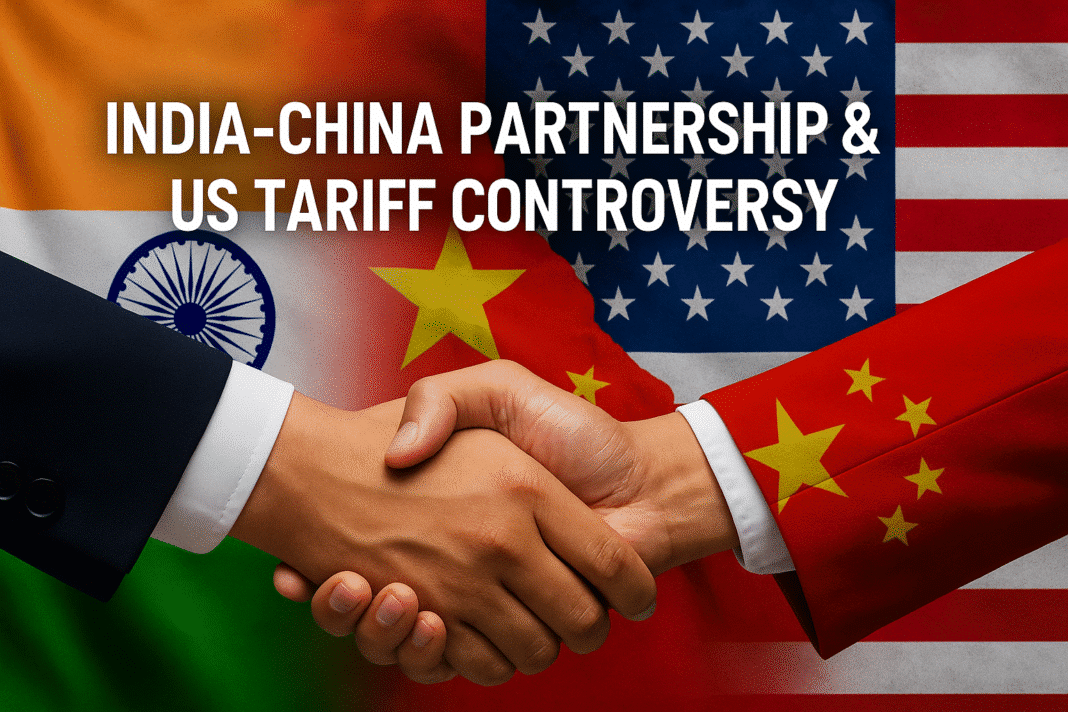
Even as tensions simmer on other fronts around the world, two of Asia’s most powerful countries. India and China, are reimagining their relationship, with an eye to friendship, not confrontation. Prime Minister Narendra Modi and President Xi Jinping issued a landmark statement in recent talks that India and China are “partners and not rivals,” signaling a major recalibration of the regional calculus. It’s no wonder this is being said at a time when the entire world is bracing for a shift in geopolitical equations and the US is under fire for launching a tariff offensive against India.
India and China are Redefining Strategic Ties
In a meet-up that had echoes of being a potential game-changer in the geopolitical landscape of Asia, the two leaders discussed having a “closer development partnership” and decided to “explore better connectivity”, while meeting on the sidelines of the Shanghai Cooperation Organisation (SCO) summit here. This was a big attempt to steer the course of bilateral interaction towards stability and the pursuit of mutual progress at a time when the shadow of continuing border tensions of the last few years was cast over any such initiatives.
Modi Xi Jinping BRICS 2026 Summit Invitation: A Diplomatic Reboot
The meetings concluded with PM Modi extending an invitation to Xi Jinping for the 2026 BRICS summit to be hosted by India. There is more to this shuffle than mere ceremony. It’s a reflection of India’s strategic choice to maintain communication channels open with China even while blending cooperation with toughness on matters that involve national interests. On 27 April, both the premier and the president emphasized that there would always be differences but these should not be disagreements, marking a practical approach toward preventing conflicts.
Why Were India and China Saying ‘Partner, Partner, Partner’?
The relationship between India and China is arguably Asia’s most important. Their new determination to play not so much adversaries as partners reflects the necessity of increasing regional trade and stabilizing their shared border as the pressures have grown. Both are regional economies significant and committed to the growth of the Indo-Pacific. In the rapidly changing world, where global alliances are shifting ever so swiftly, the twine message of peaceful coexistence by the leaders of the two countries is not just aimed at downplaying the tensions over the border but to bring about more meaningful trade relations and better understanding between the two neighbours at a global stage for instance, in institutions like BRICS (Brazil, Russia, India, China, South Africa) and the SCO (Shanghai Cooperation Organisation).
US Tariffs on India Trigger Foreign Policy Friction
Meanwhile, India’s moves in foreign trade have met with sharp resistance in the US political circles. Especially with the horsewhipping the White House gave 25% tariffs on India’s oil deals with Russia around the world. American journalist Rick Sanchez was irked by the decision saying that he was fed up with “disrespectful and ignorant” tariffs. Sanchez wrote that treating a country like India, which has long been regarded as a bulwark of strategic autonomy and global importance, as it were a “student” betrays some of the U.S.’ most flawed foreign policy instincts.
What Do the U.S. Tariffs Against India Really Mean?
The U.S. government, under former President Donald J. Trump, had slapped New Delhi with tariffs on trade with Russia to push India to reduce its reliance on Russian energy. The 25 percent tariffs are directly applicable to Indian imports of Russian crude – which come at a discount – a decision that has also raised eyebrows not only within the Indian government, but among independent analysts as well. These duties are America’s attempt to spread the tentacles of its sanctions policy on nations transacting with Russia and are also the result of America’s eternal fight on the Indian trade picks, ignoring that India has its historical and sovereign right to make independent trade decisions on its energy security.
Rick Sanchez India Comments: A Voice of Dissent
“These remarks by Rick Sanchez to a certain extent reflects a lurking feeling among some that Washington is going after India under plans that are very much in its interest strategy. (Sanchez describes (India’s) decision to press on with diversification as (Sanchez’s) phrase, in spite of such foreign pressure, as an affirmation of her economic sovereignty.
India Russia Oil Trade: Strategic and Economic Logic
It was never up to India to kick it in the oil with Russia. India’s trade in oil with Russia is a product of India’s oil strategy. With global supply chains still recovering from pandemic-related disruption and also dealing with the fallout from the conflict in Ukraine, India has opted for pragmatism. Discounted Russian oil is both a means to tame inflation and stimulate the economy in the country. Recent figures are that such trade is significant as a share of Indian oil imports, and will allow the country to fulfill its economic imperative without being booted by external power.
As events have unfolded, India’s message on this front has been clear: national interest trumps geopolitical arm-twisting. The oil issue is also a reflection of the larger question of how international relations have to respect a nation’s own determination about its need for resources and for energy.
Modi Xi Meeting at SCO: Balancing Strategy and Trust
Modi and Xi Jinping also alluded to Global instability and the pertinence of emerging economies in re-balancing and rules-based cooperation during the SCO summit. The leaders on both sides had acknowledged the need to trust and confidence building measures across the board to address the underlying issues, including border tensions, economic disparities and terrorism, Foreign Secretary Vikram Misri said.
This will clear the air for permanent peace talks and also for India and China to rethink their future entanglements – particularly in institutions such as BRICS that project a rhetoric of multilateralism. Moreover, the accession of new members in the BRICS and the India summit in 2026 will contribute further to this debate, especially with respect to trade, energy, and regional security.
Pakistan Floods News: A Humanitarian and Climate Crisis
Neighboring Pakistan, meanwhile, is struggling with a devastating humanitarian crisis as two of its closest, nuclear-armed allies battle one of the deadliest pandemics in a century. THE floods ravaging Pakistans Punjab province are the worst since the 1970s, with at least 33 people killed and 700,000 others affected. So far, the main rivers – Sutlej, Chenab and Ravi – have overtopped, inundating more than 2,200 villages and impacting nearly two million people.
It’s not just an ecological crisis, but an economic catastrophe for a farming area that is the country’s breadbasket. With the specter of large-scale food shortages and crop failures looming, Pakistan is under pressure to move with urgency. All threads of the emergency response are stretched and the lack of international aid that responds at the same speed as we do is compounding the pressure on people affected. For a nation with frequent climate crisis troubles, this flood shows how badly it needs major infrastructure and coordinated disaster-response overhaul.
Krishnanagar Murder Case: A Renewed Debate on Gender Violence
The incident was reported from a locality in Krishnanagar of West Bengal’s Nadia district, where a 19-year-old girl was shot dead in broad daylight in front of bystanders in a busy locality. The attack was reportedly motivated by her desire to end their relationship. Eyewitnesses, including members of her family, have said she was shot inside her home. Isha was taken to the hospital but was declared brought dead. The accused Debraj Singha has gone into hiding and is at large.
The killing heightened an already furious outcry throughout the country and renewed demands for women to have greater legal recognition and protection under law from domestic violence. Civil society organisations demanded education reform to incorporate behaviour change in child combative lessons and to fight early marriages to prevent a repeat of such tragedies. Image: People are demanding that the police serve up justice quicker than the society is becoming violent.
Russia-Ukraine War Drones: Strategic Escalation in the West
Further west, we also got another sinister twist in the sad saga of the Russia-Ukraine conflict: Russia declared it had shot down 112 Ukrainian drones in the space of a day. The article says Ukraine was targeting strategic port infrastructure that it presumably hoped would disrupt Moscow’s military supply chain. It had been a week since a missile attack in Kyiv had left 21 people dead including children and rescue workers.
The drone war highlights the extent to which Ukraine has rapidly developed an asymmetric answer to a conventional firepower imbalance. In the latest report from Ukraine’s Air Force, nearly half a thousand drones have attacked Kyiv which destroyed more than 30 logistical and infrastructure objects which are crucial for the civilian life and country’s defense.
Conclusion: India China Relationship at the Center of New World Order
India, China dialogue heralds nascent change in regional statecraft is overdue. With Asia bearing the brunt of COVID-19 recovery, security disruption and climate-induced emergencies, reliable India -China relations will be an axle for more productive involvement across the centre of the continent.
Meanwhile as India will mature as a international player it will develop the capability to have the international agency of its own to bank on and remain equidistance with major powers including Putin’s Russia and nurture the diplomatic armory to thwart such act economic of coercion, India has not weaned since the time of GATT on these tariffs ‘stick’ however treated as a “developing country” and therefore, India never faced the U.S. Trade Action targeting Indian exporters. With Modi inviting China’s President to the next BRICS summit, the strategic message is evident – manage competition with responsibility, focus on growth instead of geopolitics.
These will be the elements from which the new world order, the years to come will be made, as the world’s political chess board is still emerging. A pragmatically economic India, a region in clench with climatic battles, and countries gently leading around diplomacy — that is the news today, and what the history of tomorrow will read.
Frequently Asked Questions (FAQs)
What is the current stance of the India China relationship?
India and China are redefining their geopolitical ties by framing their relationship as “partners and not rivals.” This shift underscores their mutual interest in regional stability, enhanced connectivity, and trade cooperation, despite ongoing border tensions.
Why are US tariffs on India controversial?
US tariffs on India, especially 25% on Indian oil imports from Russia, are controversial for undermining India’s sovereign trade policy. Critics like Rick Sanchez argue this reflects flawed US foreign policy and disrespect for India’s strategic autonomy.
What is India’s strategy behind purchasing Russian oil?
India continues its oil trade with Russia to secure affordable energy amid global supply disruptions. This strategy is key to managing inflation and sustaining economic growth, reflecting India’s prioritization of national interest over geopolitical pressure.
How significant is Pakistan’s current flooding crisis?
Pakistan is experiencing one of its worst floods since the 1970s, affecting over 2 million people. With key rivers overflowing, the crisis has triggered food shortages, endangered livelihoods, and exposed major gaps in disaster preparedness and climate resilience.
Reference
India-China Partnership & US Tariff Controversy
Stay updated with all the latest news and insights – Global Trends Insights
Follow Us On Instagram